Places That Buy Junk Cars: A Seller-First, Decision-Driven Guide to Choosing the Right Buyer
Searching for places that buy junk cars usually means you have already decided that keeping the vehicle no longer makes sense. Maybe the car does not run. Maybe the repair estimate is higher than the car’s value. Or maybe the vehicle has simply been sitting unused, taking up space, while registration, insurance, or storage costs continue to add up.
What most sellers want is not just a buyer — they want clarity. They want to know who will actually buy the car, how the price is determined, what paperwork is required, and how to avoid the frustrating situations many people experience, such as last-minute price drops, failed pickups, or legal complications after the sale.
This guide is written specifically for U.S. sellers and focuses on real-world decision-making, not idealized marketing promises. It explains how different places that buy junk cars operate, what truly affects value, how to compare buyers correctly, and how to choose the option that best fits your situation.
What “Places That Buy Junk Cars” Really Refers To
The phrase “places that buy junk cars” is a convenience term, not an industry definition. It includes multiple buyer categories that operate under very different business models.
Common places that buy junk cars include:
- Local scrapyards
- Salvage yards and auto recyclers
- Car removal companies
- Cash-for-cars businesses
- Dealers and wholesale buyers
- Online vehicle auction and bidding platforms
Each of these buyers purchases vehicles for a different reason. Some care only about metal weight. Others care about parts demand, resale potential, or logistical efficiency. Because of this, the same vehicle can receive very different offers depending on which type of buyer you contact.
Understanding these differences is essential if you want to avoid guessing and make a decision you will not regret later.
How Places That Buy Junk Cars Determine What Your Vehicle Is Worth
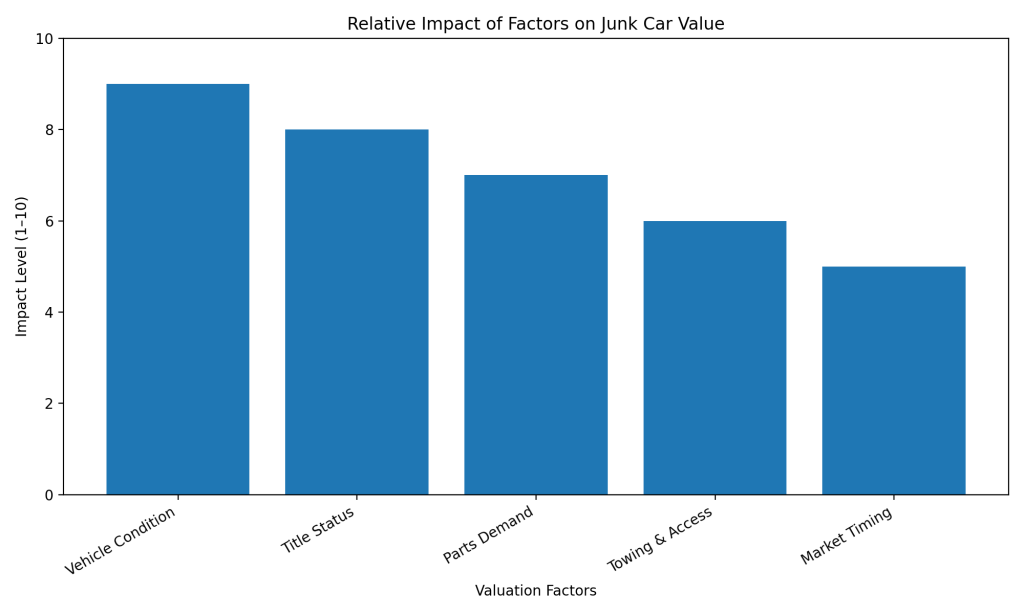
Junk car pricing is not random. Most buyers follow a predictable framework based on risk, resale pathways, and cost control. Knowing how this framework works helps you recognize fair offers and spot warning signs.
Vehicle Condition: What Buyers Actually Evaluate
Condition matters, but not in the way many sellers assume. Buyers are not emotionally attached to the vehicle. They are evaluating whether the vehicle can generate predictable value.
Factors that usually matter most:
- Whether the vehicle runs or not
- Engine or transmission failure
- Structural damage from accidents
- Flood or fire exposure
- Mileage relative to model demand
- Whether critical components are present
Cosmetic issues such as paint damage or interior wear usually have little impact unless the buyer plans to resell the car as-is. A non-running car with intact, high-demand parts can sometimes be worth more than a running car missing major components.
Title Status and Legal Transferability
Title status often determines who can buy your car at all, not just how much they will pay.
Common situations include:
- Clear title in seller’s name
- Salvage title
- Lost or misplaced title
- Title with an unresolved lien
Some places that buy junk cars can work with alternative documentation, while others cannot. Requirements vary by state, which is why sellers should confirm documentation before scheduling pickup. General guidance can be found on Homepage and /faqs, while state-specific nuances are often covered through /locations.
Towing, Access, and Location Factors
Towing is rarely free in a literal sense. It is either absorbed by the buyer or reflected in the offer amount.
Key factors include:
- Distance from buyer’s operating area
- Whether the vehicle rolls and steers
- Access constraints (garages, narrow streets, gates)
- Scheduling urgency
This is why sellers should always confirm whether the quoted amount is the final net payout, not a preliminary number subject to deductions.
Market Demand and Timing
Scrap prices and parts demand change over time. Trucks, SUVs, and popular models often retain higher value because of strong parts demand. This explains why offers can vary even within the same city.
Types of Places That Buy Junk Cars and When Each Makes Sense
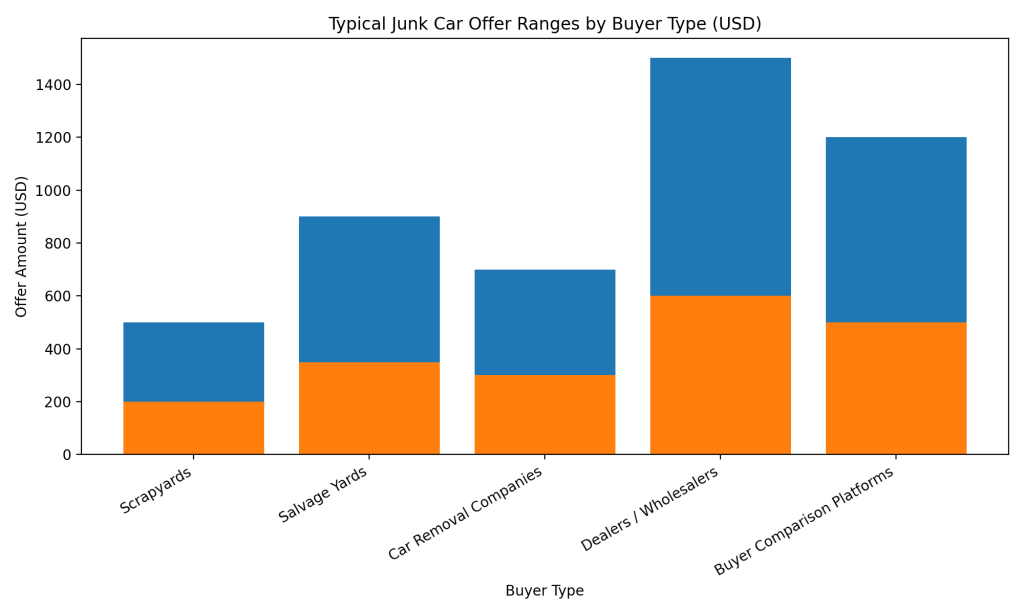
Scrapyards That Buy Junk Cars
Scrapyards focus on processing vehicles for raw materials.
Best suited for:
- Vehicles at true end-of-life
- Severe mechanical or structural damage
- Cars missing multiple key components
Advantages:
- Simple process
- Fast turnaround
Limitations:
- Typically the lowest payouts
- Strict documentation rules
Salvage Yards and Auto Recyclers
These buyers dismantle vehicles and resell usable components.
Best suited for:
- Vehicles with intact engines or transmissions
- Popular models with high parts demand
Advantages:
- Often higher payouts than scrapyards
- More nuanced valuation
Limitations:
- Detailed condition checks
- Offers may change if details differ
Car Removal Companies That Buy Junk Cars
Car removal companies emphasize speed and convenience.
Best suited for:
- Sellers who need fast removal
- Situations where time matters more than price
Advantages:
- Quick scheduling
- Minimal seller involvement
Limitations:
- Higher risk of renegotiation
- Less pricing transparency
Dealers and Wholesale Buyers
Some vehicles are considered “junk” by owners but still have resale value.
Best suited for:
- Older vehicles that still run
- Cars that are not worth private sale effort
Advantages:
- Can outperform scrap pricing
- Straightforward transactions
Limitations:
- Clear title required
- Limited eligibility
Online Buyer Comparison and Auction Platforms
These platforms expose vehicles to multiple buyers instead of relying on a single valuation.
Best suited for:
- Vehicles with unclear or mixed value signals
- Sellers who want transparency and comparison
Advantages:
- Competitive buyer exposure
- Reduced pricing guesswork
Limitations:
- Slightly longer process
- Requires accurate information
An example of this buyer-comparison approach is:
https://my.lightspeedbid.com/
Comparison Table: How Places That Buy Junk Cars Differ
| Buyer Type | Best Use Case | What Drives Value | Key Trade-Off |
| Scrapyards | End-of-life vehicles | Scrap weight | Lowest payouts |
| Salvage Yards | Parts resale | Component demand | Condition scrutiny |
| Car Removal Companies | Speed | Logistics efficiency | Price volatility |
| Dealers / Wholesalers | Running vehicles | Resale margin | Limited scope |
| Buyer Comparison Platforms | Unclear value | Market competition | Timing variance |
A Practical Decision Framework for Choosing Places That Buy Junk Cars
Instead of asking “Who pays the most?” a better question is:
Which buyer gives me the best outcome for my situation?
Consider the following trade-offs:
- Speed vs. price certainty
- Simplicity vs. comparison
- Convenience vs. control
- Documentation readiness vs. flexibility
Every seller’s situation is different. A firm, lower offer may be the right choice if you need immediate removal. A comparison-based approach may be better if value is unclear and timing is flexible.
For personalized or edge-case questions, /contact-us is the correct next step.
What to Prepare Before Contacting Places That Buy Junk Cars
Preparation protects your price and reduces friction.
Have the following ready:
- Year, make, model, and trim
- Mileage and running status
- Major mechanical or structural issues
- Missing components
- Title status
- Pickup location and access details
Clear disclosure builds trust and minimizes the risk of renegotiation at pickup.
Price Expectations: What Sellers Should Realistically Expect
There is no universal “junk car price,” but patterns do exist.
General observations:
- Vehicles sold strictly for scrap usually price lowest
- Cars with intact, high-demand parts often outperform scrap value
- Running vehicles may attract dealer or wholesale interest
- Missing titles or complex towing lowers offers
Comparing buyers within a short time window gives you a clearer sense of market reality.
Real-World Scenarios That Change Outcomes
Non-Running Vehicle With Valuable Components
Salvage-focused places that buy junk cars may significantly outbid scrapyards.
Running Vehicle With High Repair Costs
Dealers or wholesalers may see resale potential even if you do not.
Missing or Problematic Title
Buyer pool narrows quickly; preparation becomes critical.
Difficult Pickup Conditions
Access challenges often trigger price adjustments unless disclosed early.
Urgent Removal Required
Speed reduces leverage; certainty becomes more important than maximizing price.
Common Mistakes Sellers Make
- Assuming all offers are directly comparable
- Focusing on headline price instead of net payout
- Under-describing condition
- Ignoring documentation requirements
- Removing parts without disclosure
These mistakes are common — and avoidable.
Documentation and Timeline Expectations
| Situation | Typical Documents | Relative Risk |
| Clear title | Title + ID | Low |
| Lien release | Title + release | Medium |
| Lost title | State replacement forms | High |
| Non-rolling vehicle | Disclosure + access | Medium |
| Seller absent | Authorization | Medium |
Why Buyer Comparison Improves Confidence and Outcomes
When you speak with one buyer, you see one valuation logic. Buyer comparison reveals how different buyers interpret risk and opportunity. This reduces uncertainty and increases confidence in your decision.
Platforms such as
https://my.lightspeedbid.com/
exist to make this process more transparent for sellers.
Internal Resources for Further Guidance
Frequently Asked Questions About Places That Buy Junk Cars
Are all places that buy junk cars legitimate?
No. Transparency, documentation clarity, and consistent pricing are key indicators of legitimacy.
Is “free towing” really free?
Only if confirmed as part of the final net payout.
Can I sell a junk car without a title?
Sometimes, depending on state law and buyer policy.
Why do offers vary so much?
Different buyers monetize vehicles in different ways.
Final Thoughts: Choosing the Right Places That Buy Junk Cars
Selling a junk car is not just about getting rid of a vehicle. It is about choosing the option that aligns with your timing, paperwork, and risk tolerance. The best outcomes come from understanding how buyers think, preparing properly, and comparing options when value is unclear.
Approach the process with clarity instead of urgency, and you can sell your junk car with confidence and minimal surprises.