When people research scrap cars, they are usually trying to solve a practical problem: removing an unwanted vehicle while recovering fair value and avoiding legal or logistical headaches. What makes this process confusing is that scrapping a vehicle is not a single-step transaction. It involves recycling economics, parts recovery, towing logistics, and state-specific ownership rules.
This guide explains scrap cars from a decision and market perspective, not a sales angle. You will learn how value is determined, why offers vary, what paperwork matters most, and how to avoid common mistakes that lead to pickup delays or last-minute price changes.
For platform context, service coverage, and documentation help, you can also review the Homepage, FAQs , Locations , or reach out directly via contact-us.
What Scrap Cars Actually Mean in Real Transactions
Scrap cars are vehicles sold for end-of-life processing, not for continued driving. That does not mean the vehicle has no value. It means the buyer’s intent is recovery, not resale as transportation.
A vehicle typically enters this category when:
- Repair costs outweigh practical value
- Inspection or compliance issues make resale risky
- The owner prioritizes removal and closure
- The vehicle is damaged, non-running, or incomplete
The important point is this: buyers do not all evaluate end-of-life vehicles the same way, which is why outcomes differ even for similar vehicles.
Scrap Cars vs Junk Cars vs Salvage Vehicles
These terms are often used interchangeably, but they represent different buyer models.
| Term | Typical Meaning |
| Scrap cars | Vehicles sold for recycling or parts recovery |
| Junk cars | Informal label, overlaps but less precise |
| Salvage vehicles | Insurance total-loss vehicles |
| End-of-life vehicles | Regulatory and recycling term |
This page focuses on scrap cars as a market category, not as a marketing label.
The Scrap Car Value Funnel (How Buyers Actually Decide)
Instead of listing random pricing factors, it is more accurate to understand value through a structured funnel. Every scrap transaction passes through these four stages.
Stage 1: Vehicle Reality of Scrap Cars
This includes:
- Completeness (engine, transmission, catalytic converter)
- Mobility (runs, rolls, or seized)
- Type of damage or failure
Stage 2: Recovery Reality of Scrap Cars
This includes:
- Reusable components
- Metal composition
- Environmental handling requirements
Stage 3: Logistics Reality of Scrap Cars
This includes:
- Distance to pickup
- Access difficulty
- Loading time and equipment needs
Stage 4: Compliance Reality of Scrap Cars
This includes:
- Title or ownership documentation
- State disposal rules
- Identity verification
Every offer is the output of this funnel, not a flat number pulled from a chart.
Scrap Cars and Market Economics
Why Different Buyers Value the Same Vehicle Differently
Two buyers may produce different offers for the same vehicle because:
- One focuses on dismantling and parts resale
- One focuses on metal recycling only
- One has nearby towing capacity
- One has higher compliance overhead
This is why there is no universal “best price” for scrap cars.
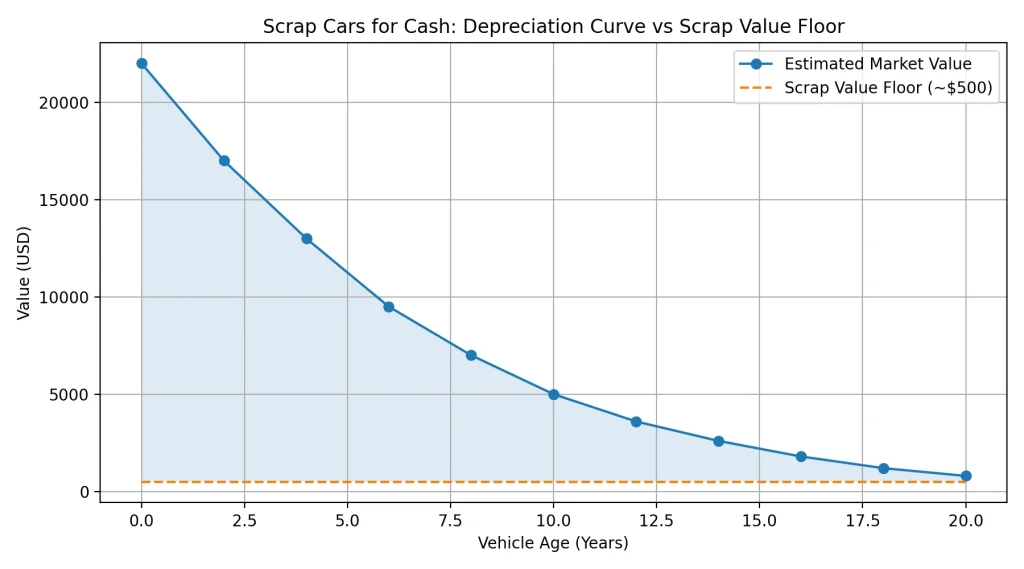
Why Scrap Car Prices Per Ton Rarely Match Real Offers
Online metal pricing reflects raw material value, not transaction value. It does not account for:
- Towing
- Labor
- Missing components
- Regulatory handling
These costs are real and must be absorbed by the buyer.
Condition Factors That Truly Matter
Complete Vehicles
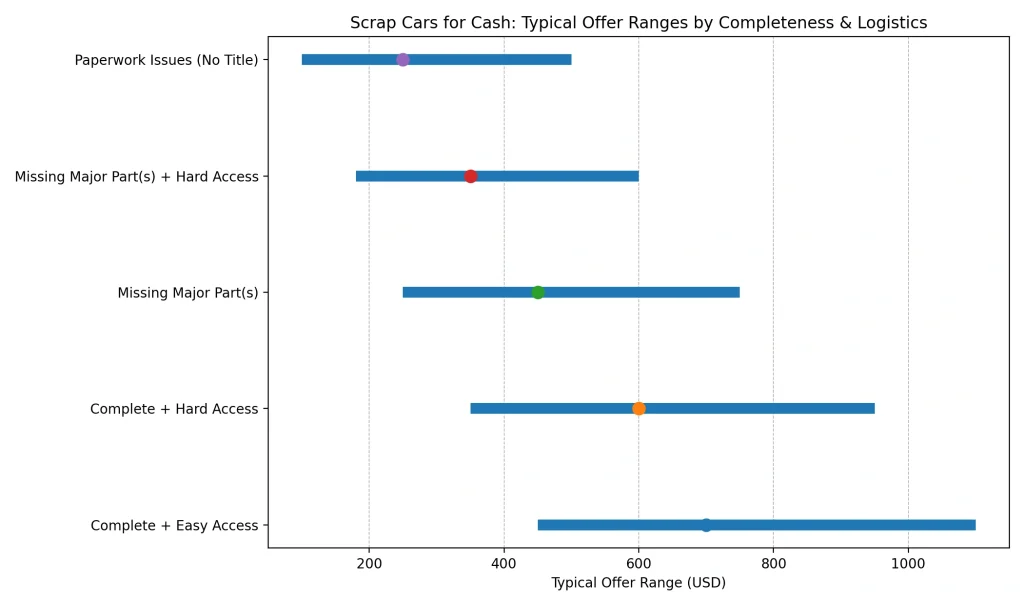
Vehicles with all major components intact are easier to process and usually produce more stable outcomes.
High-impact components include:
- Catalytic converter
- Engine
- Transmission
- Wheels
Vehicles Missing Parts
When key components are missing, recoverable value drops and labor increases. This often leads to conservative offers or conditional pricing.
Non-Running Vehicles
A vehicle does not need to run to be processed efficiently. What matters is whether it:
- Rolls
- Steers
- Can be accessed easily
Accurate disclosure prevents pickup-day renegotiation.
Pickup Logistics and Why They Affect Value
Easy-Access Vehicles
Vehicles parked in open, accessible areas are faster to load and cheaper to collect.
Restricted-Access Vehicles
Offers may change when:
- Vehicles are blocked in
- Stored in garages with limited clearance
- Located on soft ground
- Positioned in tight urban spaces
Describing access clearly improves pricing stability.
Legal and Documentation Considerations
Ownership and Title Requirements
Most states require proof of ownership for lawful disposal. Common issues include:
- Missing titles
- Incorrect signatures
- Estate or lien situations
These do not always prevent a sale, but they often slow it.
For documentation guidance, consult faqs before scheduling pickup.
Regulated Disposal Responsibilities
End-of-life vehicles contain fluids, batteries, and other regulated materials. Compliant handling affects buyer cost structures and processing timelines.
Real-World Scenarios That Change Outcomes of Scrap Cars
Vehicles After Accidents
Collision damage does not eliminate recovery value. In some cases, demand for undamaged components remains strong.
Flood-Damaged Vehicles
Flood exposure increases handling risk due to contamination concerns and may limit recovery options.
Rural or Remote Locations
Distance affects towing economics. Confirm coverage through Locations before proceeding.
Scrap Cars vs Donation Paths
Donation and scrapping are different decisions with different goals.
| Option | Best For |
| Scrapping for cash | Removal and financial outcome |
| Donation | Charitable impact |
| Private sale | Drivable vehicles |
Choosing the wrong path often creates frustration.
Buyer Comparison and Transparency of Scrap Cars
Single-buyer pricing hides market variance. Comparing offers reveals how differently buyers value the same vehicle.
Platforms like LightSpeedBid structure vehicle data so multiple buyers evaluate the same information. This reduces guesswork and improves transparency for sellers.
Offer review and buyer comparison occur through the secure portal at
👉 https://my.lightspeedbid.com/
For orientation and next steps, you can always return to the Homepage.
Common Mistakes That Reduce Outcomes of Scrap Cars
Overstating Condition
Misrepresentation leads to disputes at pickup.
Ignoring Access Challenges
Tow logistics matter more than many sellers realize.
Assuming All Buyers Follow the Same Rules
Documentation and acceptance criteria vary.
Anchoring on Marketing Guarantees
Promotional claims rarely reflect real logistics.
Frequently Asked Questions
How much are scrap cars worth?
Value depends on completeness, recovery potential, logistics, and documentation readiness.
Are vehicles always paid by weight?
No. Weight is only one input among many.
Is towing usually included?
Often yes, but access and distance matter.
Can a vehicle be sold without a title?
Sometimes, depending on state rules and buyer policy.
Why do offers change?
Usually due to undisclosed condition or access issues.
Final Perspective
Scrap cars are not simple transactions. They are end-of-life assets moving through economic, logistical, and regulatory systems. Understanding how buyers evaluate these vehicles helps you avoid surprises and make informed decisions.