Introduction: why scrap cars for cash is not as simple as it sounds
Searching scrap cars for cash usually means you want to get rid of an old, damaged, or unwanted vehicle and receive money without delays, confusion, or last-minute surprises. Many people assume scrapping a car is straightforward: call a buyer, schedule pickup, get paid. In reality, outcomes vary widely.
The amount you receive that depends on vehicle condition, parts demand, scrap metal markets, towing logistics, paperwork readiness, and how individual buyers operate. Two sellers with similar vehicles can receive very different offers simply because buyers evaluate risk and recovery differently.
This guide explains how scrap cars for cash actually works in the United States, what determines pricing, how to avoid common mistakes, and how to get predictable results instead of guesswork. If you are new to the process, start with the Homepage to understand the overall flow of modern junk car transactions.
Scrap cars for cash explained clearly
Scrap cars for cash means selling a vehicle primarily for its recoverable materials and reusable components rather than continued road use. Buyers evaluate each vehicle as an asset made up of metal, parts, and logistics cost. The final payout is the result of what the buyer can recover minus what it costs them to collect, process, and legally transfer the vehicle.
There is no universal price. Scrap cars for cash outcomes are calculated individually based on real-world factors.
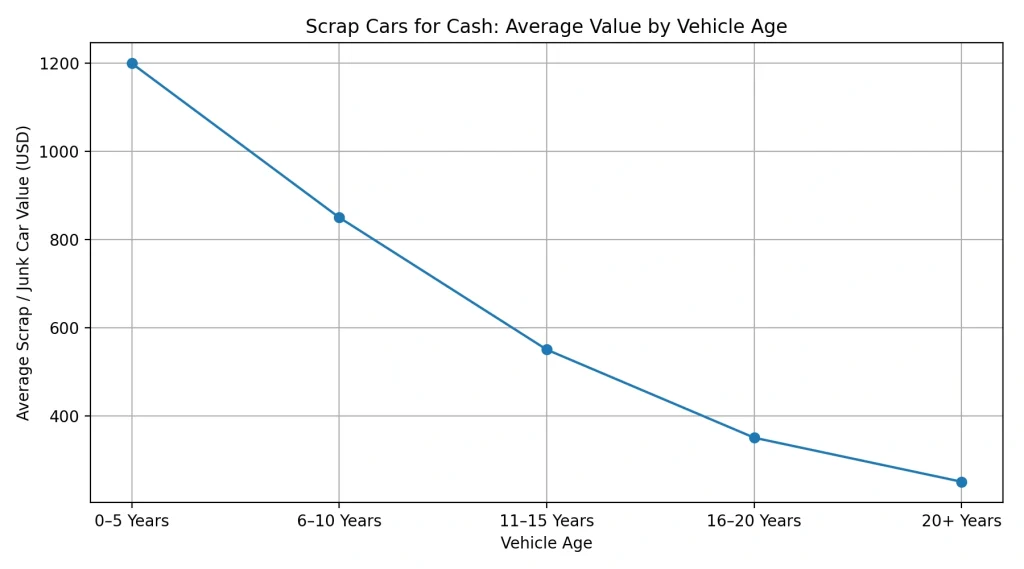
How scrap cars for cash pricing actually works
Scrap cars for cash and vehicle condition
Condition is one of the most important pricing variables. Buyers look beyond whether a car runs. They evaluate how much effort is required to extract value.
Vehicles usually receive stronger scrap cars for cash offers when they:
- Are complete (engine, transmission, catalytic converter present)
- Are not burned or flood-damaged
- Are not severely rusted
- Retain core electronics and wiring
Stripped or heavily damaged vehicles require more labor and often yield less recoverable value.
| Pricing Factor | What Buyers Look At | Why It Affects Scrap Cars for Cash Offers |
| Vehicle Completeness | Engine, transmission, catalytic converter | Missing components reduce recoverable value |
| Vehicle Condition | Burn, flood, rust, accident damage | Higher labor and processing risk lowers offers |
| Scrap Metal Prices | Steel and aluminum market rates | Sets the minimum value floor |
| Parts Demand | Engines, converters, body panels | Strong demand can raise offers significantly |
| Towing Logistics | Distance, access, mobility | Higher transport cost reduces net payout |
| Paperwork Status | Title and ownership clarity | Compliance risk causes deductions or delays |
scrap metal prices
Scrap metal pricing sets the baseline for many offers. Steel and aluminum prices fluctuate based on demand and global supply. When scrap prices rise, baseline payouts rise. When scrap prices fall, payouts compress.
Heavier vehicles such as trucks and SUVs generally benefit more from scrap pricing than very small cars. This is why timing matters even when the vehicle itself has not changed.
parts demand
Not all buyers rely only on metal. Some dismantle vehicles and resell parts before scrapping the shell. In these cases, parts demand can significantly increase value.
High-impact components include:
- Engines and transmissions
- Catalytic converters
- Body panels in demand
- Certain electronics and sensors
A vehicle with strong parts demand may receive a higher scrap cars for cash offer than a heavier vehicle with no reusable components.
Scrap cars for cash and running vs non-running vehicles
Running vehicles reduce uncertainty. A car that starts and moves is easier to load and inspect. Even if it is not reliable, mobility lowers processing risk.
However, non-running scrap cars for cash transactions are common. A non-running vehicle can still receive a fair offer if it:
- Rolls and steers
- Is complete
- Is accessible for towing
Vehicles that cannot roll or are blocked often require specialized equipment, which reduces payouts.
Scrap cars for cash and towing logistics
Towing is always a cost. Buyers factor in:
- Distance from service area
- Accessibility (garage, driveway, street)
- Vehicle mobility
- Time required for loading
Most scrap cars for cash offers include towing under standard conditions. Difficult access or long distances increase cost and reduce offers. Checking service coverage on locations helps align expectations.
Scrap cars for cash and paperwork requirements
Legitimate buyers require proof of ownership and identification. Title issues introduce compliance risk and extra administrative work.
If paperwork is unclear, buyers may:
- Lower the offer
- Delay pickup
- Decline the transaction
Before scheduling pickup, review documentation basics on faqs or ask questions through contact-us.
Scrap cars for cash scenarios and what to expect
| Scrap Car Scenario | Buyer Evaluation Focus | Pickup Difficulty | Offer Stability | Typical Outcome |
| Running but unwanted | Parts + ease of handling | Low | High | Above-baseline offers |
| Non-running, complete | Scrap + limited parts | Medium | Medium | Fair market offers |
| Accident-damaged | Severity and access | Medium–High | Medium | Reduced pricing |
| Missing catalytic converter | Lost high-value component | Medium | Low | Significant deductions |
| Non-rolling / blocked | Specialized towing needed | High | Low | Lower net payout |
| No title / paperwork issues | Compliance risk | Medium | Very Low | Delays or rejections |
Scrap cars for cash with a running but unwanted vehicle
Running vehicles often receive higher offers because they are easier to process. Even if repairs are not economical, mobility improves buyer confidence and reduces handling cost.
Scrap cars for cash with a non-running vehicle
Non-running vehicles are common in scrap transactions. Offers depend on completeness and accessibility. A complete non-runner that rolls and steers is far easier to collect than one that does not.
Scrap cars for cash after an accident
Accident damage affects value based on severity. Vehicles with intact drivetrains and accessible locations can still receive solid offers. Severe frame damage, deployed airbags, or missing parts reduce value.
Scrap cars for cash in rural or remote locations
Distance matters. Buyers operate within defined service zones. Vehicles located far outside those zones incur higher transport costs. Confirm coverage using locations instead of assuming statewide service.
Scrap cars for cash without a title
Some states allow alternative documentation for older vehicles, but not all buyers participate. Expect additional verification steps and potentially lower offers. Clarify requirements before scheduling to avoid delays.
Common mistakes sellers make
Assuming all scrap cars pay the same
There is no flat rate. Age, weight, condition, and location all matter.
Relying on scrap calculators
Online calculators ignore towing, parts demand, and compliance costs. They are estimates, not offers.
Hiding missing parts
Missing catalytic converters, wheels, or engines are the top causes of pickup-day deductions.
Prioritizing speed over clarity
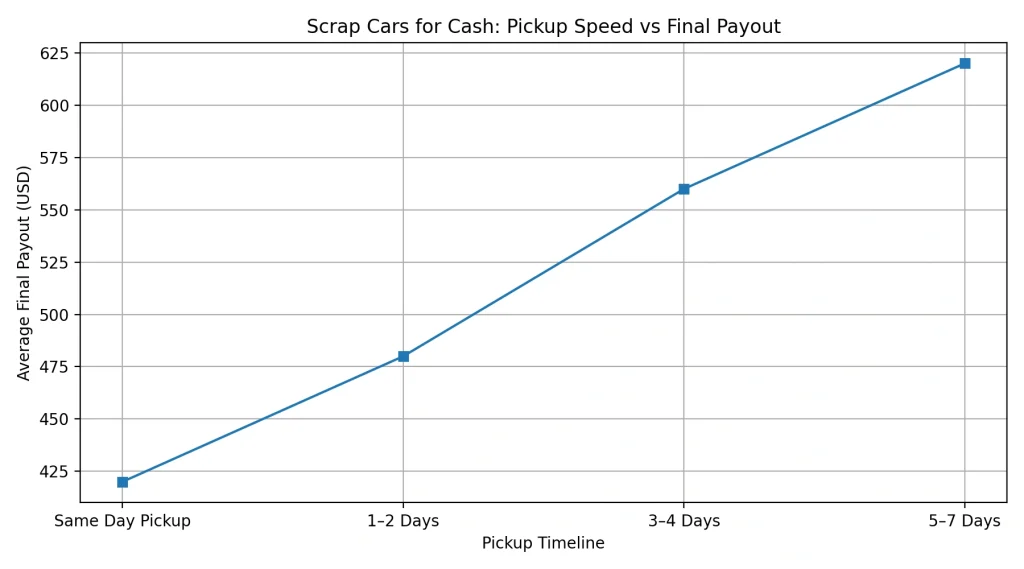
Same-day pickup is convenient but often comes with conservative pricing. Flexibility usually improves outcomes.
Why comparing buyers improves scrap cars for cash results
A single buyer offer reflects that buyer’s recovery model and constraints, not the entire market. Comparing buyers reveals:
- Realistic pricing ranges
- Tradeoffs between speed and payout
- Whether parts demand exists for your vehicle
LightSpeedBid operates as a direct buying and comparison platform, helping standardize vehicle details so offers are based on consistent information rather than assumptions. Sellers who proceed typically review offers through the secure portal:
👉 https://my.lightspeedbid.com/
For process clarity, explore the Homepage and review common questions on faqs. Service coverage details are available on locations, and support is accessible via contact-us.
FAQs
How much money do you usually get for scrap cars for cash?
It depends on condition, scrap prices, parts demand, towing, and paperwork. There is no fixed amount.
Do scrap cars for cash services include free pickup?
Often under standard conditions. Difficult access or long distances can affect pricing.
Can I scrap a car that does not run?
Yes, if it is complete and can be loaded. Non-rolling vehicles usually receive lower offers.
What paperwork is required to scrap a car for cash?
Proof of ownership and identification are typical. Requirements vary by state.
Is it better to scrap a car locally or compare buyers?
Comparing buyers provides transparency and reduces guesswork.
Final takeaway: scrap cars for cash done the right way
Scrap cars for cash is a practical solution for unwanted vehicles, but outcomes depend on more than just weight or age. Vehicle condition, parts demand, scrap markets, towing logistics, and paperwork all influence final payouts. Sellers who understand these factors and compare how different buyers value the same details experience fewer surprises and more predictable results.