Selling an old car is no longer a simple transaction. In today’s market, an aging vehicle exists at the intersection of resale economics, liability transfer, documentation compliance, and local buyer models. Most online articles focus narrowly on price or speed. This document serves a different purpose.
This page functions as a reference-grade explainer for individuals seeking to sell an older vehicle while minimizing uncertainty, legal exposure, and wasted effort. It explains how the system actually works, what determines outcomes, and how to choose a path that aligns with the vehicle’s real market classification.
For official process context and coverage, you may also reference the Homepage , review common scenarios in FAQs , confirm regional availability via Locations , or reach out directly through Contact Us.
What “Old Car” Means in Market Terms (Not Age)
“Sell an Old Car” is not defined solely by model year. In the market, a vehicle becomes “old” when it crosses a risk threshold where continued ownership or resale requires increasing tradeoffs.
These thresholds are influenced by:
- Mileage relative to expected lifecycle
- Frequency of repairs
- Reliability predictability
- Declining buyer liquidity
- Regulatory or inspection constraints
Two vehicles of the same age may fall into entirely different markets. Understanding which market applies is the foundation of a successful outcome.
The Vehicle Transfer Lifecycle: Sell an Old Car
This document introduces the Vehicle Transfer Lifecycle (VTL) — a three-phase model used to evaluate and execute the sale or disposition of older vehicles.
| Lifecycle Phase | What This Phase Confirms | Seller Responsibility | Risk If Skipped |
| Pre-Transfer Qualification | Ownership, title, access, feasibility | Verify documents, disclose condition, confirm access | Deals collapse, price drops |
| Custody Transfer | Physical vehicle handoff | Be present or reachable, confirm payment | Payment disputes, no-shows |
| Legal Termination | End of seller liability | Release ownership, handle plates, confirm records | Ongoing legal exposure |
Phase 1: Pre-Transfer Qualification to sell an old car
Purpose: determine feasibility and risk before committing.
Includes:
- Ownership verification
- Title and lien status
- Identity confirmation
- Vehicle completeness disclosure
- Access and location validation
Failures in this phase are responsible for most collapsed transactions.
Phase 2: Custody Transfer to sell an old car
Purpose: move physical possession without assuming legal closure.
Includes:
- Visual condition confirmation
- Pickup or handoff execution
- Payment settlement (method varies)
- Custody acknowledgment
Custody transfer does not equal liability transfer.
Phase 3: Legal Termination for sell an old car
Purpose: end seller responsibility completely.
Includes:
- Ownership release
- Registration disengagement
- Plate handling (state-dependent)
- Disposal or resale pathway assignment
Only after Phase 3 is complete does seller exposure end.
Market Classification Models for Old Vehicles
Every older vehicle is evaluated under one of four downstream models. Pricing, speed, and buyer behavior are direct consequences of this classification.
| Model | Description |
| Retail Continuation | Vehicle resold for continued use |
| Reconditioning | Repairs performed before resale |
| Component Recovery | Parts extraction prioritized |
| Material Recycling | Weight-based processing |
Misalignment between seller expectations and buyer classification is the most common cause of renegotiation.
Value Is an Output, Not an Input
Price is not determined by age alone. It is the result of:
- Market classification
- Condition transparency
- Documentation integrity
- Logistics cost
- Regional demand
Online valuation tools often assume a retail resale path, which is inaccurate for many older vehicles. This explains why offers vary widely.
High-Mileage Vehicles: How Buyers Actually Think
Mileage influences risk perception, not mechanical reality. Buyers assess:
- Engine behavior
- Transmission consistency
- Maintenance continuity
- Warning indicators
A well-documented high-mileage car often outperforms a lower-mileage vehicle with unknown history.
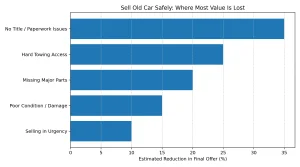
Non-Running Vehicles and Access Constraints
When a vehicle does not run, valuation shifts toward logistics and recovery feasibility.
Critical factors include:
- Rolling and steering capability
- Physical access
- Equipment requirements
- Component completeness
- Ownership documentation
Clear disclosure stabilizes offers and prevents last-minute changes.
Documentation Integrity and Compliance
Most US states require:
- Proof of ownership
- Valid identification
- Odometer disclosure (when applicable)
- Bill of sale or notice of transfer
- Lien resolution (if applicable)
Missing documentation does not always prevent a sale, but it narrows buyer options and slows execution.
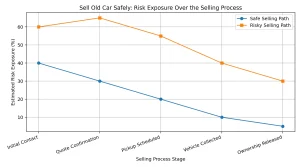
Risk Exposure and Failure Patterns
Observed failure patterns include:
- Vehicle removed but ownership not released
- Title discrepancies discovered post-pickup
- Buyer classification mismatch
- Improper plate handling
- Delayed settlement disputes
Each failure maps directly to an incomplete lifecycle phase.
Role of Comparison Infrastructure
when you sell an old car, comparison-based platforms exist to reduce information asymmetry by standardizing vehicle data and exposing buyer variability.
One example is LightSpeedBid, which enables structured offer review via a secure portal:
👉 https://my.lightspeedbid.com/
Such platforms fun
ction as process infrastructure, not buyers.
DecisionMatrix for Sellers
Before proceeding, confirm:
- Vehicle classification is realistic
- Documentation is verified
- Access logistics are clear
- Timeline aligns with buyer model
- Legal termination steps are understood
Predictable outcomes follow predictable inputs.
Conclusion: Selling an Old Car Is a Process, Not a Price
Selling an old car is best understood as a controlled transfer process rather than a price-chasing exercise. The safest and most efficient outcomes result from accurate classification, complete lifecycle execution, and early documentation clarity.